| timezone |
|---|
UTC+8 |
GitHub ID: niko4570
Telegram: @oxfffk
A web3 lover from china, is learning smart contract audit
Google’s Agent2Agent (A2A) Protocol (announced April 9, 2025) standardizes AI agent communication over HTTP(S) with JSON-RPC 2.0. It enables discovery, task delegation, and secure collaboration across providers. Open-source on GitHub (v0.3.0).
Benefits: Interoperability, discoverability via Agent Cards, built-in security (OAuth2, API keys).
See official spec.
Agent Cards: Agent “Profiles”
JSON metadata published by server agents; fetched by clients for discovery.
Example JSON snippet:
{
  "protocolVersion": "0.3.0",
  "name": "Travel Planner",
  "skills": [{ "id": "flight-book", "tags": ["travel"] }]
}
Task Flow
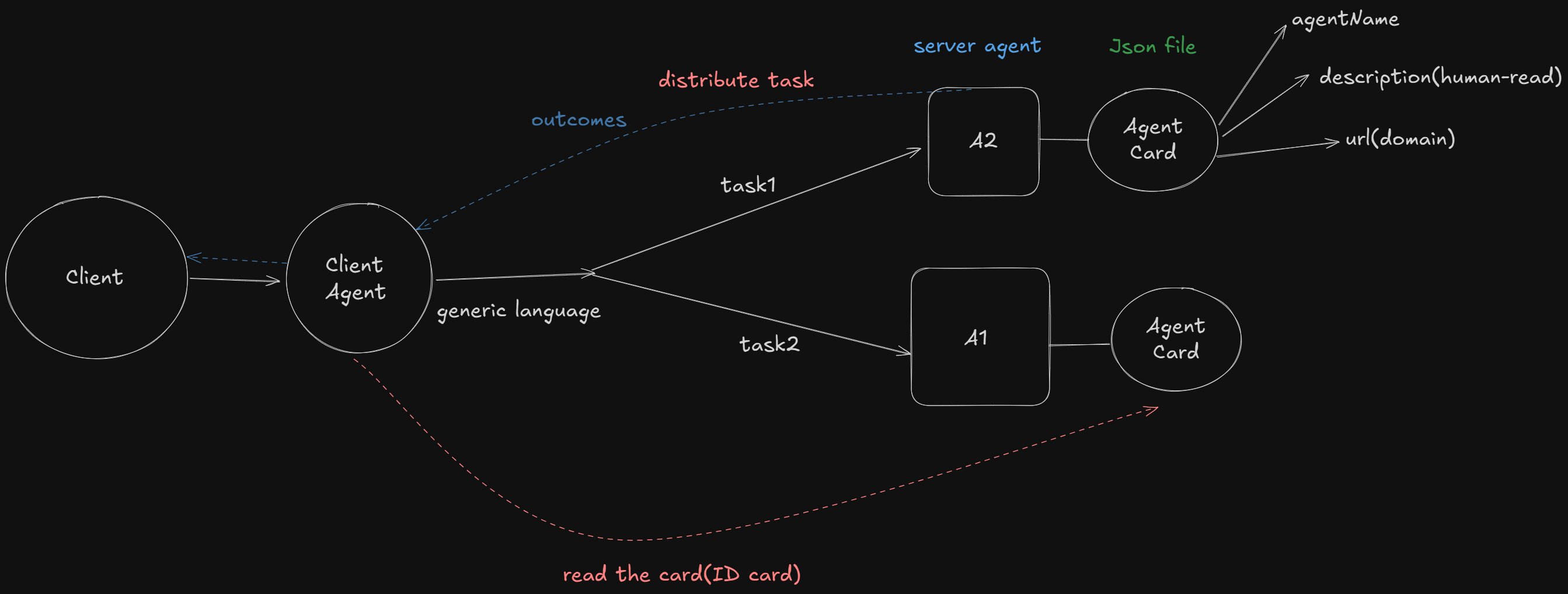
User inputs natural language to client agent, which discovers servers via cards, delegates subtasks, aggregates outcomes.
Mermaid Diagram:
Steps: Input → Discover → Delegate (JSON-RPC) → Execute → Synthesize.
Human Social Analogy
A2A mirrors social norms for smooth teamwork.
| A2A Element | Social Equivalent | Parallel |
|---|---|---|
| Agent Card | Resume/Business Card | Quick fit-check |
| Task Distribution | Party Delegation | Assign roles via tags |
| Generic Input | Casual Chat | No jargon; interpret |
| Outcomes | Follow-Ups | Accountability loop |
Like a networking event: Host (client agent) scouts profiles and divides labor.
Implementation
-
Server: Serve card at /.well-known/agent.json; handle JSON-RPC.
-
Client:Fetch/parse cards; route tasks.
-
Python Snippet:
  import requests
  card = requests.get("https://example.com/.well-known/agent.json").json()
  print(card["skills"])
What is protocol ?
It’s just rules in AI as same as rules in human society.
Current AI Agents are predominantly centralized “black boxes”—opaque systems controlled by a few large entities (e.g., tech giants like OpenAI or Google), where users have little visibility into decision-making processes, data handling, or potential biases. This centralization creates trust barriers: without transparency, users must blindly rely on the provider for reliability, security, and ethical alignment, especially in cross-organizational multi-agent collaboration scenarios. EIP-8004 addresses this by enabling trustless interactions via blockchain, fostering an open agent economy where agents can discover and collaborate without pre-existing relationships. The motivation is to scale AI beyond silos, using pluggable trust models (e.g., reputation or validation) proportional to risk—from low-stake tasks like simple queries to high-stake ones like diagnostics—while ensuring censorship-resistant discovery and verifiable signals.
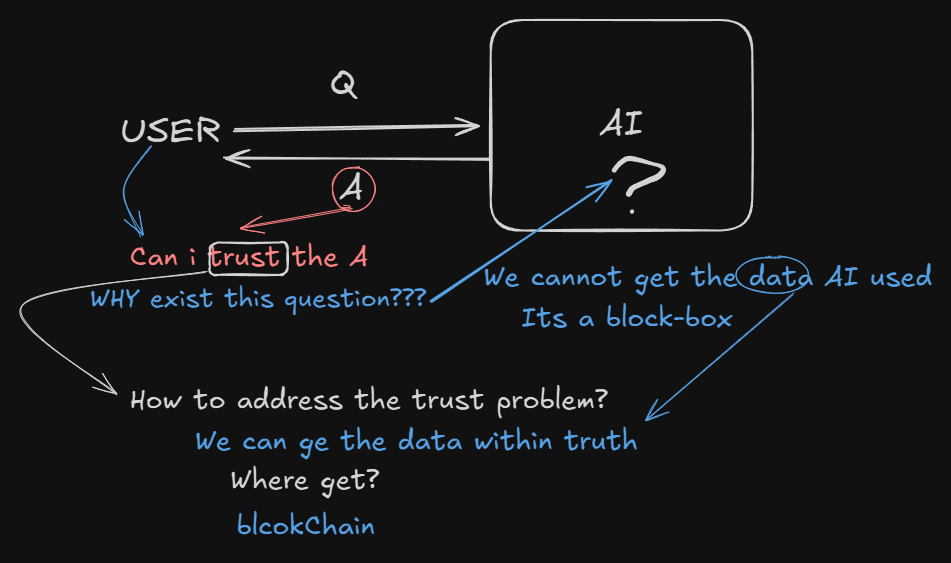
To make AI Agents truly trustless, data and interactions must be open, verifiable, and tamper-proof, which blockchain excels at by providing immutable, decentralized ledgers. EIP-8004 solves this through three interconnected on-chain registries (Identity, Reputation, and Validation) deployed as ERC-721-based smart contracts on Ethereum Mainnet or L2s. These registries ensure data authenticity via hashes (e.g., KECCAK-256 for IPFS files), signed authorizations (EIP-191/ERC-1271), and public events for composability. Key ideas:
-
Open Data: Agent metadata (e.g., capabilities, endpoints) is stored off-chain (IPFS/HTTP) but committed on-chain via URIs, making it browsable and auditable.
-
Truth Assurance: Blockchain consensus verifies identities and signals (e.g., feedback scores 0-100), mitigating Sybil attacks through filtering and stake-secured validation.
-
Pluggable Models: Choose reputation (client feedback), crypto-economic validation (staked re-execution), zkML proofs, or TEE oracles—tiered by risk.
This integration turns centralized black boxes into decentralized, verifiable systems, aligning with your point on open, true data via blockchain.
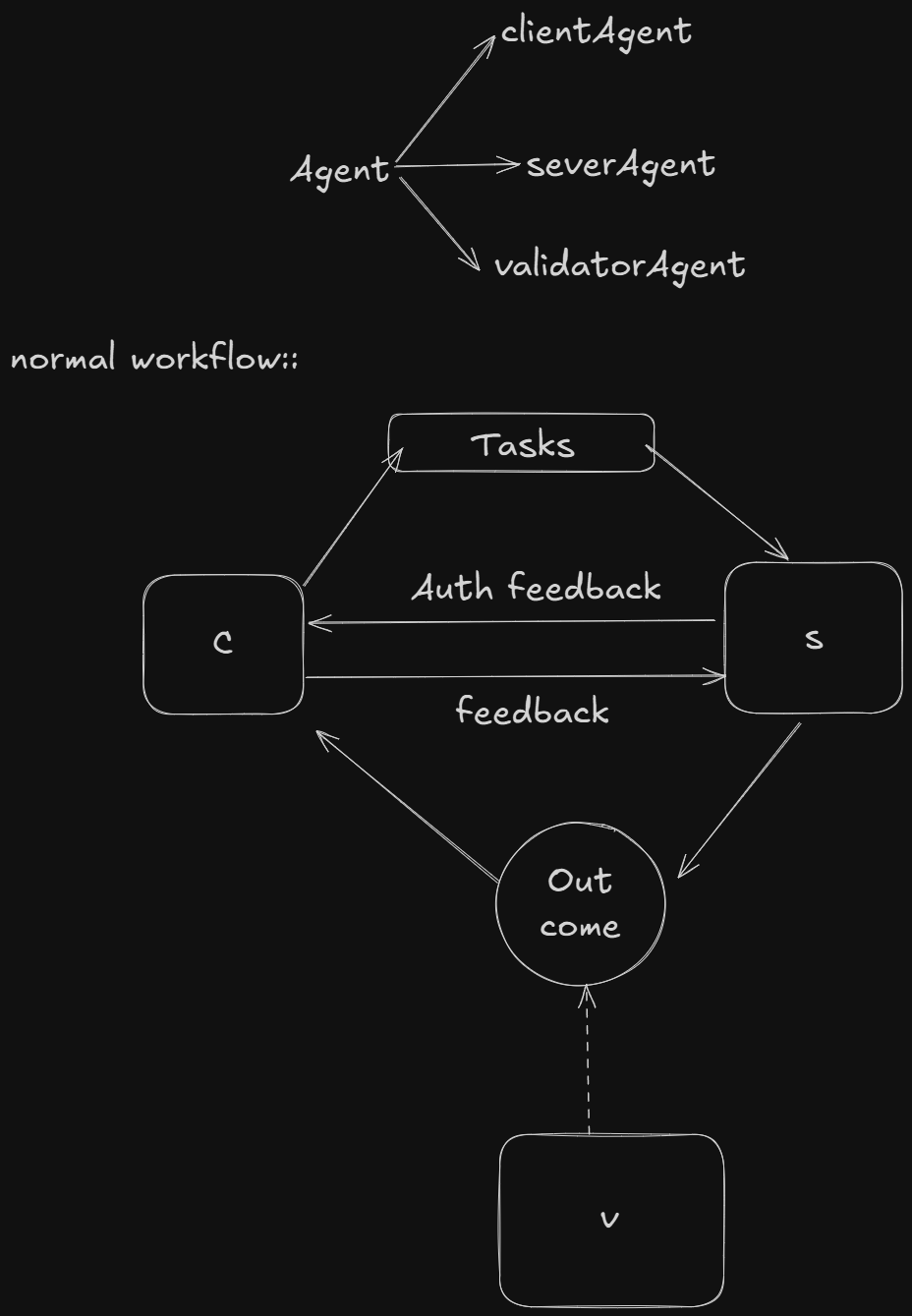
The trustless agent workflow in EIP-8004 follows a structured, iterative process emphasizing discovery, interaction, and verification without central authority. It builds on off-chain protocols like A2A (for messaging) and MCP (for capabilities), with on-chain enforcement for trust. Here’s the standard flow:
| Step | Description | Key Components |
|---|---|---|
| 1. Discovery | Client agent (user or orchestrator) queries the Identity Registry (ERC-721) to browse agents by ID. Resolves tokenURI to an off-chain JSON file for details like endpoints (e.g., A2A URL), skills, and supportedTrust (e.g., “reputation”). Filter by reputation/validation summaries from other registries. | Identity Registry; Global ID: (eip155, chainId, registryAddr, agentId). |
| 2. Selection & Interaction | Client selects a server agent based on trust signals (e.g., avg score >80). Initiates task via off-chain endpoint (e.g., A2A message for orchestration). Server executes (e.g., AI computation) and returns artifacts. | Off-chain: A2A/MCP; On-chain: Pre-check summaries. Roles: Client (requester), Server (provider). |
| 3. Feedback (Reputation Model) | Post-task, server signs a feedbackAuth tuple (agentId, clientAddr, indexLimit, expiry, etc.). Client submits to Reputation Registry: giveFeedback(score, tags, fileuri, hash, auth). Optional: Revoke or append responses. | Reputation Registry; Emits NewFeedback; Aggregates via getSummary. |
| 4. Validation (If Needed) | For high-risk tasks, server (or client) requests via Validation Registry: validationRequest(validatorAddr, agentId, requestUri, hash). Independent validator (e.g., staker or zk-prover) re-executes/verifies and responds: validationResponse(hash, score, responseUri, tag). Client queries status. | Validation Registry; Emits ValidationRequest/Response; Models: zkML, TEE. Role: Validator (verifier). |
| 5. Iteration & Settlement | Use aggregates for future selections. Payments orthogonal (e.g., x402 proofs in feedback files). Loop for multi-agent chains. | Cross-chain via multi-registrations; Gas sponsorship (EIP-7702) for ease. |
This workflow ensures accountability: low-trust tasks rely on reputation; high-trust add validation, all verifiable on-chain.