This repository contains my solutions for challenges on distributed algorithms.
Build and run programs using:
$ sbt run
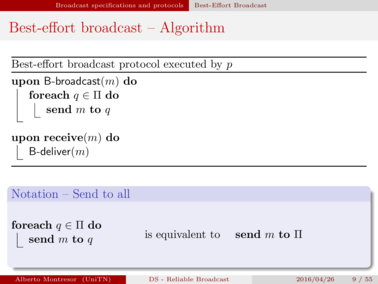
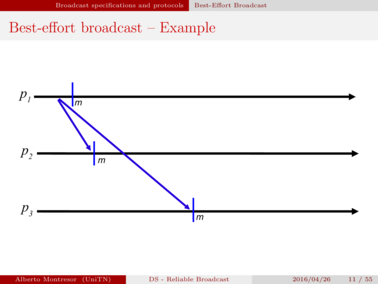
Implementation of a best-effort broadcast protocol:
$ sbt "runMain com.github.dlorch.BestEffortBroadcast.Main"
[p3] message delivered: Hello, distributed world!
[p1] message delivered: Hello, distributed world!
[p2] message delivered: Hello, distributed world!
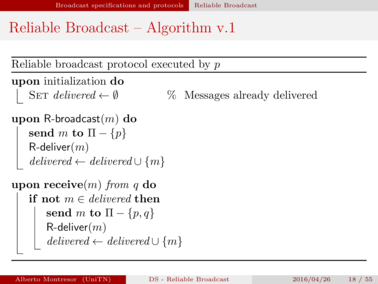
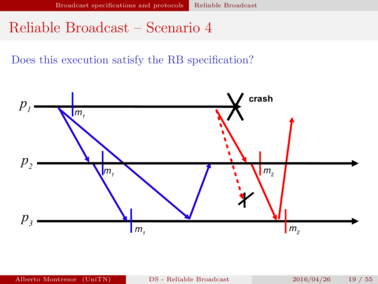
Implementation of reliable broadcast protocol. Here, p1 sends message to p2, then crash-stops. Since p2 sends to p3, all correct processes eventually deliver the message:
$ sbt "runMain com.github.dlorch.ReliableBroadcast.Main"
[p1] crashed
[p2] message delivered: Hello, reliable world!
[p3] message delivered: Hello, reliable world!
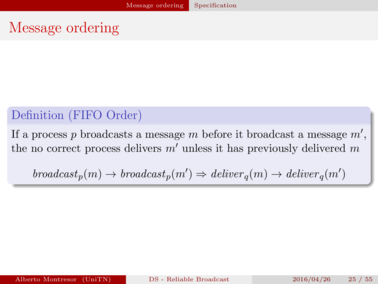
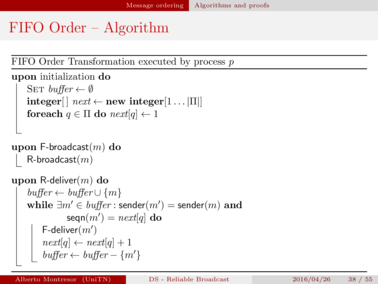
Implementation of FIFO broadcast protocol, which is a "FIFO Order transformation applied to a
reliable broadcast". In the example below, a message with sequence number 3 arrives out-of-order.
Each process receive()s and stores it in its buffer, because it is expecting sequence number
2 first. When the message with sequence number 2 finally arrives, all processes deliver()
messages 2 and 3 in the correct sequence to the process.
$ sbt "runMain com.github.dlorch.FIFOBroadcast.Main"
[p1] [seqn: 1] initiating reliable broadcast: 1st message
[p1] [seqn: 1] message delivered: 1st message
[p2] [seqn: 1] message delivered: 1st message
[p3] [seqn: 1] message delivered: 1st message
[p1] [seqn: 3] initiating reliable broadcast: 3rd message
[p1] [seqn: 2] initiating reliable broadcast: 2nd message
[p1] [seqn: 2] message delivered: 2nd message
[p2] [seqn: 2] message delivered: 2nd message
[p2] [seqn: 3] message delivered: 3rd message
[p1] [seqn: 3] message delivered: 3rd message
[p3] [seqn: 2] message delivered: 2nd message
[p3] [seqn: 3] message delivered: 3rd message
The key component of the FIFO Order transformation is the next table, kept at each node. This
variable keeps track of the expected next sequence number from its peer processes. The next
table at each process looks like this:
| Peer Process | Next Sequence Number |
|---|---|
| p1 | 1 |
| p2 | 1 |
| p3 | 1 |
At the beginning of the execution, the next tables in the entire system look like this:
| p1 Peer |
Next |
p2 Peer |
Next |
p3 Peer |
Next |
|---|---|---|---|---|---|
| p1 | 1 | p1 | 1 | p1 | 1 |
| p2 | 1 | p2 | 1 | p2 | 1 |
| p3 | 1 | p3 | 1 | p3 | 1 |
At the end of the execution, the next tables in the entire system look like this:
| p1 Peer |
Next |
p2 Peer |
Next |
p3 Peer |
Next |
|---|---|---|---|---|---|
| p1 | 4 | p1 | 4 | p1 | 4 |
| p2 | 1 | p2 | 1 | p2 | 1 |
| p3 | 1 | p3 | 1 | p3 | 1 |
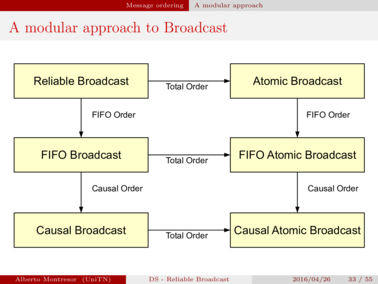
For any two events a and b, if there is any way that a could have influenced b, then
a happened-before b and the two events are causally related. It is also possible to
have two events where we cannot say which came first; when that happens, it means that they
could not have affected each other. If a and b cannot have any effect on each other,
then it does not matter which one came first (Source: Lamport timestamps).
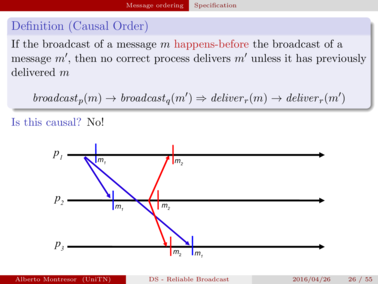
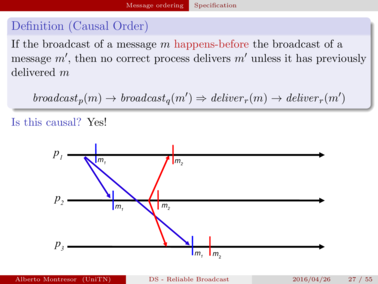
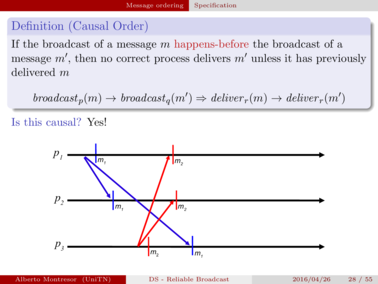
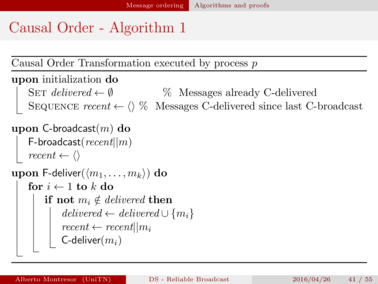
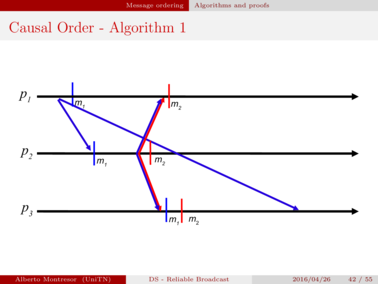
The following is an attempt to re-create the scenario from Causal Order - Algorithm 1.
First p1 broadcasts a message m1 (suppose the message says "Buy milk") to all its peers, but due
to network delays can only reach itself and p2. Then, p2 broadcasts a message m2 (suppose it
is "Sell milk"). Note that the two messages are causally related. When p2 broadcasts its message
m2, it also includes its recent history, a sequence or list [m1], along with it. p3 will
thus receive m2 along with the history [m1] and correctly deliver the messages in causal order.
Implementation of a non-blocking causal order protocol:
$ sbt "runMain com.github.dlorch.CausalOrderNonBlockingBroadcast.Main"
[p1] [sender: p1, seqn: 1] message delivered: Buy milk
[p2] [sender: p1, seqn: 1] message delivered: Buy milk
[p3] joined the party late
[p2] [sender: p2, seqn: 1] message delivered: Sell cheese
[p3] [sender: p1, seqn: 1] message delivered: Buy milk
[p1] [sender: p2, seqn: 1] message delivered: Sell cheese
[p3] [sender: p2, seqn: 1] message delivered: Sell cheese
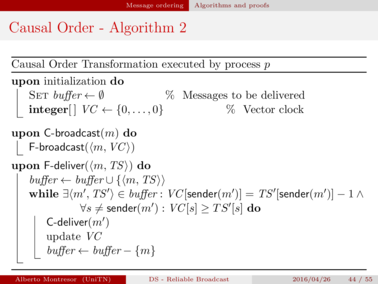
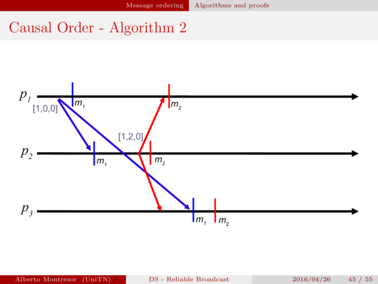
Implementation of a blocking causal order broadcast protocol based on vector clocks, where "blocking" means that the process may delay the delivery of a message for a later time.
[p2] [sender: p1, seqn: 1] message delivered: Buy milk
[p1] [sender: p1, seqn: 1] message delivered: Buy milk
[p3] [sender: p1, seqn: 1] message delivered: Buy milk
[p2] [sender: p2, seqn: 1] message delivered: Sell cheese
[p3] [sender: p2, seqn: 1] message delivered: Sell cheese
[p1] [sender: p2, seqn: 1] message delivered: Sell cheese