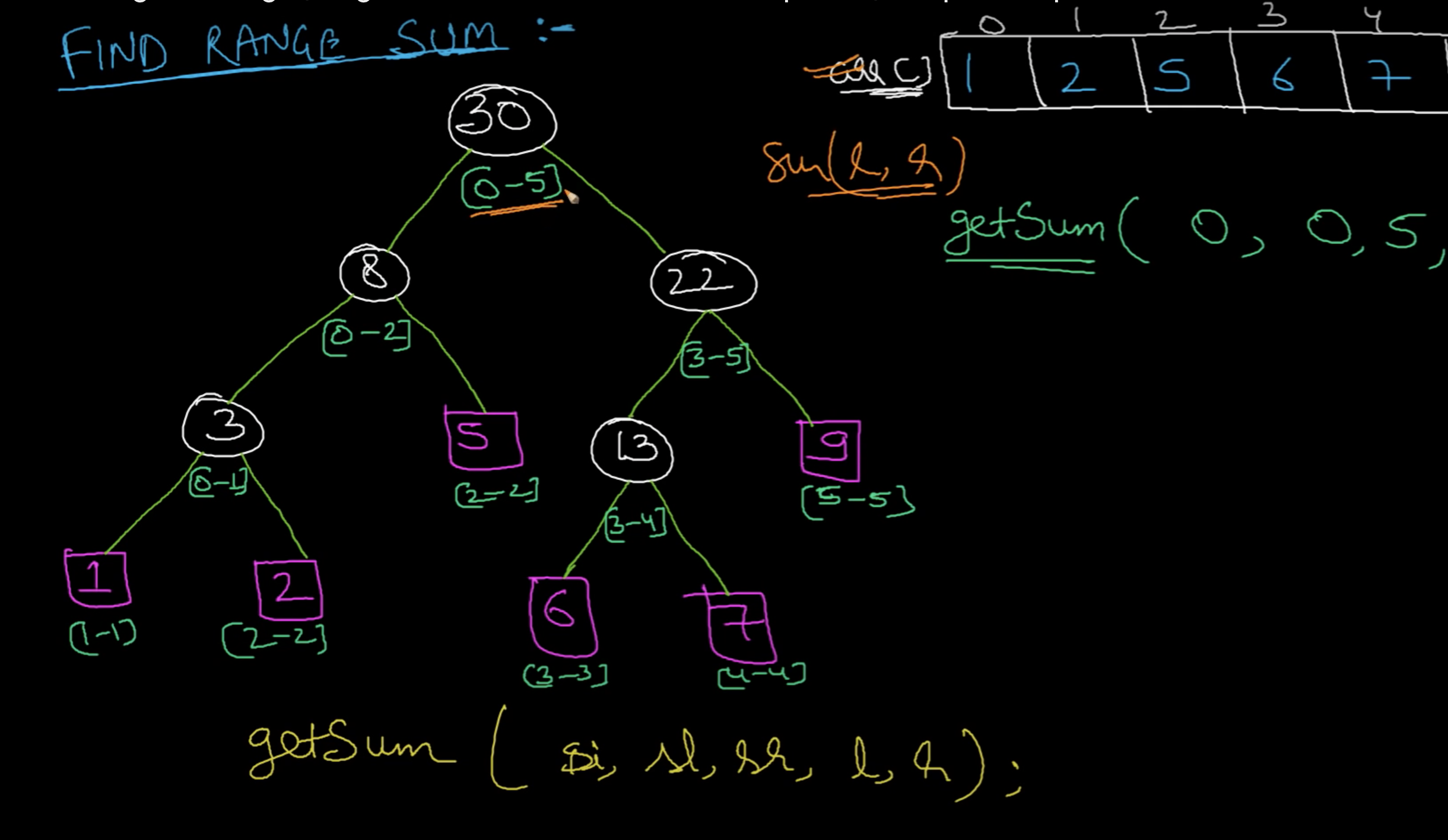
- A Segment Tree is a data structure that stores information about array intervals as a tree.
- This allows answering range queries over an array efficiently, while still being flexible enough to allow quick modification of the array.
Segment Tree is useful when the array has many "update" operations in intervals. Read more
Video Tutorial - https://www.youtube.com/watch?v=2bSS8rtFym4&ab_channel=TECHDOSE
void updateValue(vector<int>& st, int start, int end, int updatingIdx, int diff, int idx) {
    // To be updated idx is outside range
    if (updatingIdx < start || updatingIdx > end)
        return;

    //Idx is in the range of this node, update the value
    // of this node and its children
    st[idx] += diff;
    if (start != end) {
        int mid = start + (end - start) / 2;
        updateValue(st, start, mid, updatingIdx, diff, 2 * idx + 1);
        updateValue(st, mid + 1, end, updatingIdx, diff, 2 * idx + 2);
    }
}

int getSum(vector<int>& st, int start, int end, int searchStartIdx, int searchEndIdx, int idx) {
    // Case 1: Full overlaping condition
    // Segment of the node is part of the range
    // --searchStartIdx-- start ---- end ---searchEndIdx---
    if (searchStartIdx <= start && searchEndIdx >= end)
        return st[idx];

    // Case 2: NO-overlap condition
    // ---end -- searchStartIdx--
    // ---searchEndIdx -- start--
    if (end < searchStartIdx || start > searchEndIdx)
        return 0;

    // Case 3: Partial Overlap
    int mid = start + (end - start) / 2;
    return getSum(st, start, mid, searchStartIdx, searchEndIdx, 2 * idx + 1) +
           getSum(st, mid + 1, end, searchStartIdx, searchEndIdx, 2 * idx + 2);
}

int fillSTValues(vector<int>& nums, vector<int>& st, int start, int end, int idx) {
    // If there is only single element in array, store in st
    // and return it
    if (start == end) {
        st[idx] = nums[start];
        return nums[start];
    }

    // Split at any pivot into left and right subtrees
    // and store their sum into current node
    int mid = start + (end - start) / 2;
    st[idx] = fillSTValues(nums, st, start, mid, 2 * idx + 1) +
              fillSTValues(nums, st, mid + 1, end, 2 * idx + 2);

    return st[idx];
}

void buildST(vector<int>& nums, vector<int>& st) {
    //allocate memory for segement tree
    int n = nums.size();
    int height = ceil(log2(n));

    //Maximum size of segment tree
    int max_size = 2 * pow(2, height) - 1;

    st.resize(max_size);
    fillSTValues(nums, st, 0, n - 1, 0);
}

int main() {
    vector<int> nums = {1, 3, 5, 7, 9, 11};
    int n = nums.size();

    //build segment tree
    vector<int> st;
    buildST(nums, st);

    //Find sum in range - output = 32
    int searchStartIdx = 2, searchEndIdx = 5;
    cout << getSum(st, 0, n - 1, searchStartIdx, searchEndIdx, 0) << endl;

    //Update value
    int newValue = 7, updatingIdx = 2;
    int diff = newValue - nums[updatingIdx];
    updateValue(st, 0, n - 1, diff, updatingIdx, 0);

    //Find sum range again - output = 34
    cout << getSum(st, 0, n - 1, searchStartIdx, searchEndIdx, 0) << endl;

    return 0;
}