[](https://github.com/tigercosmos/node-color-log/actions/workflows/test.yml)
[](https://badge.fury.io/js/node-color-log)
[](https://www.npmjs.com/package/node-color-log)
[](https://deepwiki.com/tigercosmos/node-color-log)
# Node Color Log
A lightweight and more JavaScript logger for NodeJS and browsers.
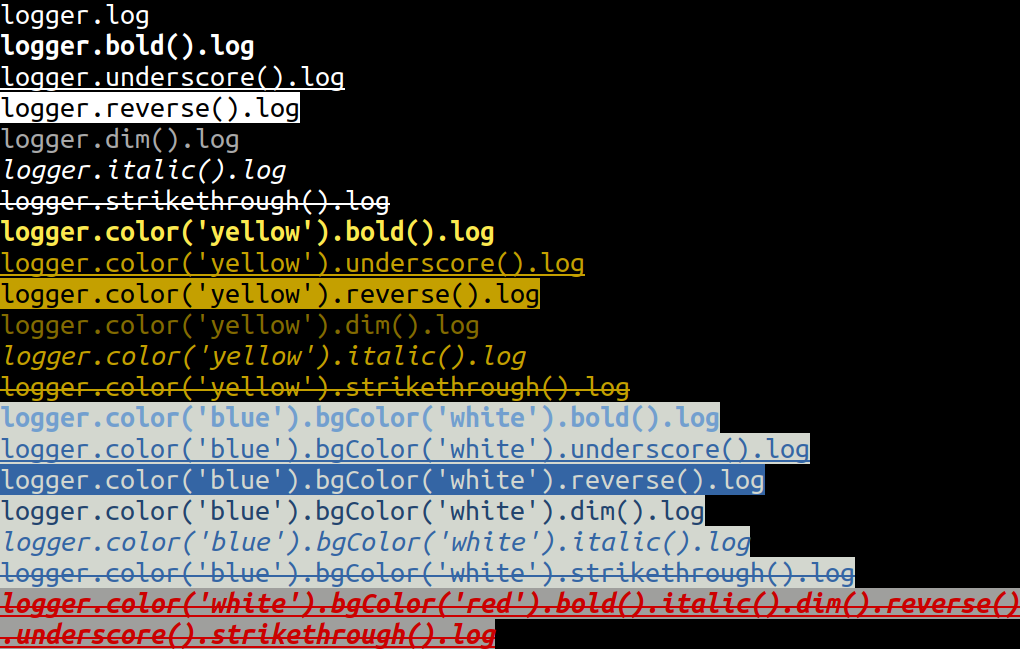
`node-color-log` is a logger package for NodeJS and browsers. It provides more functions than the origin `console.log`. You can log text with colorful fonts and colorful backgrounds. Also, it has 4 levels log, including `debug`, `info`, `warn` and `error`. Give you a much better experience while developing JavaScript projects.
Winston and Pino are famous loggers for JavaScript, but they are too heavy and fancy. Sometimes we just want to have a simple logger, and don't want to spend time learning a fancy library. Then, `node-color-log` is your best choice.
## Demo

 ## Usage
### Install
Install package in your project:
```bash
npm install node-color-log@latest --save
```
### Import
Put the following code in your `js` in which you want to log.
```javascript
const logger = require('node-color-log');
```
Logger level can be set like this. Logs belongs to this level and above that level will be printed.
```javascript
logger.setLevel("error"); // it can be any log level.
```
## API
### `log()`
log with attributes, the order of setters can change.
**NOTE:** `log()` need to put behind of attribute setter(at the end).
`append()` can appends the contents in one line. (Note: old `joint` is now deprecated.)
`color()` and `bgColor()` includes: `black`, `red`, `green`, `yellow`, `blue`, `magenta`, `cyan`, `white`.
`reset()` can clear the previous attributes in the same line.
Usage:
```javascript
// normal log
logger.log(message)
// Attribute log
logger.color('red').bgColor('blue')
.bold().italic().dim().reverse().underscore().strikethrough()
.log(message);
// use `append` to joint contents, and use `log` to print out at the end
logger.color('red').bold().append('message_style_1')
.bgColor('white').italic().append('message_style_2')
.strikethrough().log('message_style_3');
// use `reset` to clean the attributes
logger.bgColor('red').append('background red color message')
.reset() // by calling this, background is reset
.log('default background color message');
// log multiple arguments
logger.log(obj1, arr2, str3);
```
### `setLogStream`
You can redirect the logs to the stream.
For example, you can write the log into the file:
```js
fileStream = fs.createWriteStream('test.log'),
logger.setLogStream(fileStream)
logger.log("hi");
logger.error("hello", "world");
fileStream.close()
```
You can use `less -R test.log` to see the result.
### `enableFileAndLine()`
Print the filename and line information in the logs. Note that this may increase a little performance overhead.
```js
logger.enableFileAndLine(true /* enable */);
logger.debug('This log should include file and line information.');
// 2025-07-23T18:43:27.199Z[/Users/tigercosmos/node-color-log/index.js:157] [DEBUG] This log should include file and line information.
logger.enableFileAndLine(true /* enable */, true /* short file name */);
logger.debug('This log should include file and line information.');
// 2025-07-23T18:43:27.200Z[index.js:157] [DEBUG] This log should include file and line information.
```
### `fontColorLog()`, `bgColorLog()`, `colorLog()`
- `message` here must be a string.
- Color includes: `black`, `red`, `green`, `yellow`, `blue`, `magenta`, `cyan`, `white`.
- `setting` is optional. Keys in `setting` need to be boolean, and all are `false` by default.
Parameters:
```javascript
const color = 'red';
const message = 'any string you will put into console.log';
const setting = {
bold: true,
dim: true,
underscore: true,
reverse: true,
italic: true,
strikethrough: true
}
```
Usage:
```javascript
// only set font color
logger.fontColorLog('red', message, setting);
// only set background color
logger.bgColorLog('yellow', message, setting);
// set font and background color
logger.colorLog({
font: 'black',
bg: 'yellow'
}, message, setting);
```
### `success()`, `debug()`, `info()`, `warn()`, `error()`
With prefix that has background color
Usage:
```javascript
// Success level, with prefix "[SUCCESS]"
logger.success(message);
// debug level, with prefix "[DEBUG]"
logger.debug(message);
// Info level, with prefix "[INFO]"
logger.info(message);
// Warn level, with prefix "[WARN]"
logger.warn(message);
// Error level, with prefix "[ERROR]"
logger.error(message);
// Level logs enable multiple arguments
logger.debug(obj1, arr2, str3);
```
The output looks like:
```log
2018-08-14T18:23:09.836Z [SUCCESS] This is success mode
2018-08-14T18:23:09.837Z [DEBUG] This is debug mode
2018-08-14T18:23:09.838Z [INFO] This is info mode
2018-08-14T18:23:09.838Z [WARN] This is warn mode
2018-08-14T18:23:09.839Z [ERROR] This is error mode
```
### `setLevel()` & `LOGGER` environment variable
If you want to set mask for levels, simply add the line at the front. Levels below the setting level will all be hidden. There are four levels, which are `success`, `debug`, `info`, `warn`, `error`, or `disable` in lower-case.
```js
logger.setLevel("info"); // success < debug < info < warn < error < disable
logger.debug("This `debug` will be hidden");
logger.error("This `error` will be shown");
logger.setLevel("disable"); // hide every logs
```
Or, you can set the environment variable `LOGGER`, such as `LOGGER=info npm start`, where it's equal to `setLevel("info")`.
### `setLevelNoColor()`, `setLevelColor()`
Level logs print in colors as a default.
You can set `setLevelNoColor()` to turn off the setting, and use `setLevelColor()` to reverse it.
None color mode is helpful for text files or browser environments.
```js
logger.setLevelNoColor();
```
### `setDate()`
The default time format is `toISOString`, but you can change it by using `setDate(callback)`
```javascript
logger.setDate(() => (new Date()).toLocaleTimeString())
logger.info("This is an info message") // 5:17:59 pm [INFO] This is an info message
```
### `createNamedLogger()`
You can create a named logger by calling `createNamedLogger()`
```javascript
logger1 = logger.createNamedLogger("Test 1");
logger2 = logger.createNamedLogger("Test 2");
logger1.info('something happened'); // 2022-08-20T04:56:17.834Z [Test 1] [INFO] something happened
logger2.info('something happened'); // 2022-08-20T04:56:17.835Z [Test 2] [INFO] something happened
```
### Contribute
Any issues and PRs are very welcome!
### License
MIT
## Usage
### Install
Install package in your project:
```bash
npm install node-color-log@latest --save
```
### Import
Put the following code in your `js` in which you want to log.
```javascript
const logger = require('node-color-log');
```
Logger level can be set like this. Logs belongs to this level and above that level will be printed.
```javascript
logger.setLevel("error"); // it can be any log level.
```
## API
### `log()`
log with attributes, the order of setters can change.
**NOTE:** `log()` need to put behind of attribute setter(at the end).
`append()` can appends the contents in one line. (Note: old `joint` is now deprecated.)
`color()` and `bgColor()` includes: `black`, `red`, `green`, `yellow`, `blue`, `magenta`, `cyan`, `white`.
`reset()` can clear the previous attributes in the same line.
Usage:
```javascript
// normal log
logger.log(message)
// Attribute log
logger.color('red').bgColor('blue')
.bold().italic().dim().reverse().underscore().strikethrough()
.log(message);
// use `append` to joint contents, and use `log` to print out at the end
logger.color('red').bold().append('message_style_1')
.bgColor('white').italic().append('message_style_2')
.strikethrough().log('message_style_3');
// use `reset` to clean the attributes
logger.bgColor('red').append('background red color message')
.reset() // by calling this, background is reset
.log('default background color message');
// log multiple arguments
logger.log(obj1, arr2, str3);
```
### `setLogStream`
You can redirect the logs to the stream.
For example, you can write the log into the file:
```js
fileStream = fs.createWriteStream('test.log'),
logger.setLogStream(fileStream)
logger.log("hi");
logger.error("hello", "world");
fileStream.close()
```
You can use `less -R test.log` to see the result.
### `enableFileAndLine()`
Print the filename and line information in the logs. Note that this may increase a little performance overhead.
```js
logger.enableFileAndLine(true /* enable */);
logger.debug('This log should include file and line information.');
// 2025-07-23T18:43:27.199Z[/Users/tigercosmos/node-color-log/index.js:157] [DEBUG] This log should include file and line information.
logger.enableFileAndLine(true /* enable */, true /* short file name */);
logger.debug('This log should include file and line information.');
// 2025-07-23T18:43:27.200Z[index.js:157] [DEBUG] This log should include file and line information.
```
### `fontColorLog()`, `bgColorLog()`, `colorLog()`
- `message` here must be a string.
- Color includes: `black`, `red`, `green`, `yellow`, `blue`, `magenta`, `cyan`, `white`.
- `setting` is optional. Keys in `setting` need to be boolean, and all are `false` by default.
Parameters:
```javascript
const color = 'red';
const message = 'any string you will put into console.log';
const setting = {
bold: true,
dim: true,
underscore: true,
reverse: true,
italic: true,
strikethrough: true
}
```
Usage:
```javascript
// only set font color
logger.fontColorLog('red', message, setting);
// only set background color
logger.bgColorLog('yellow', message, setting);
// set font and background color
logger.colorLog({
font: 'black',
bg: 'yellow'
}, message, setting);
```
### `success()`, `debug()`, `info()`, `warn()`, `error()`
With prefix that has background color
Usage:
```javascript
// Success level, with prefix "[SUCCESS]"
logger.success(message);
// debug level, with prefix "[DEBUG]"
logger.debug(message);
// Info level, with prefix "[INFO]"
logger.info(message);
// Warn level, with prefix "[WARN]"
logger.warn(message);
// Error level, with prefix "[ERROR]"
logger.error(message);
// Level logs enable multiple arguments
logger.debug(obj1, arr2, str3);
```
The output looks like:
```log
2018-08-14T18:23:09.836Z [SUCCESS] This is success mode
2018-08-14T18:23:09.837Z [DEBUG] This is debug mode
2018-08-14T18:23:09.838Z [INFO] This is info mode
2018-08-14T18:23:09.838Z [WARN] This is warn mode
2018-08-14T18:23:09.839Z [ERROR] This is error mode
```
### `setLevel()` & `LOGGER` environment variable
If you want to set mask for levels, simply add the line at the front. Levels below the setting level will all be hidden. There are four levels, which are `success`, `debug`, `info`, `warn`, `error`, or `disable` in lower-case.
```js
logger.setLevel("info"); // success < debug < info < warn < error < disable
logger.debug("This `debug` will be hidden");
logger.error("This `error` will be shown");
logger.setLevel("disable"); // hide every logs
```
Or, you can set the environment variable `LOGGER`, such as `LOGGER=info npm start`, where it's equal to `setLevel("info")`.
### `setLevelNoColor()`, `setLevelColor()`
Level logs print in colors as a default.
You can set `setLevelNoColor()` to turn off the setting, and use `setLevelColor()` to reverse it.
None color mode is helpful for text files or browser environments.
```js
logger.setLevelNoColor();
```
### `setDate()`
The default time format is `toISOString`, but you can change it by using `setDate(callback)`
```javascript
logger.setDate(() => (new Date()).toLocaleTimeString())
logger.info("This is an info message") // 5:17:59 pm [INFO] This is an info message
```
### `createNamedLogger()`
You can create a named logger by calling `createNamedLogger()`
```javascript
logger1 = logger.createNamedLogger("Test 1");
logger2 = logger.createNamedLogger("Test 2");
logger1.info('something happened'); // 2022-08-20T04:56:17.834Z [Test 1] [INFO] something happened
logger2.info('something happened'); // 2022-08-20T04:56:17.835Z [Test 2] [INFO] something happened
```
### Contribute
Any issues and PRs are very welcome!
### License
MIT