


Example of simple Windows driver compiled on Linux using Mingw. Performs I/O to BIOS POST port 0x80.
Compile the driver testdrv.sys from source testdrv.c
/*
  Windows device driver minimal example:
  Handles RW single byte on BIOS POST I/O port 0x80

  Compile on Linux using mingw:
  /usr/bin/x86_64-w64-mingw32-gcc -Wl,-L"/usr/x86_64-w64-mingw32/lib/" -I"/usr/x86_64-w64-mingw32/include/ddk" -Wall -m64 -shared -Wl,--subsystem,native -Wl,--image-base,0x10000 -Wl,--file-alignment,0x1000 -Wl,--section-alignment,0x1000 -Wl,--entry,DriverEntry@8 -Wl,--stack,0x40000 -Wl,--dynamicbase -Wl,--nxcompat -nostartfiles -nostdlib -o testdrv.sys testdrv.c -lntoskrnl -lhal
*/

#include <ntddk.h>
#include <wdm.h>

#define DEVNAME L"\\Device\\TestDriver"
#define SYMLINK L"\\??\\TestDriver"

void byte2hex(void *byte, int bytelen, char *hex, int hexlen);
void hex2byte(void *byte, int bytelen, char *hex, int hexlen);
NTSTATUS TestDriverCreateClose(_In_ PDEVICE_OBJECT DeviceObject, _In_ PIRP Irp);
NTSTATUS TestDriverRead(_In_ PDEVICE_OBJECT DeviceObject, _In_ PIRP Irp);
NTSTATUS TestDriverWrite(_In_ PDEVICE_OBJECT DeviceObject, _In_ PIRP Irp);
void Unload(_In_ PDRIVER_OBJECT DriverObject);

DRIVER_INITIALIZE DriverEntry;

NTSTATUS DriverEntry(PDRIVER_OBJECT DriverObject, PUNICODE_STRING RegistryPath)
{
   UNREFERENCED_PARAMETER(DriverObject);
   UNREFERENCED_PARAMETER(RegistryPath);
   UNICODE_STRING devName = RTL_CONSTANT_STRING(DEVNAME);
   PDEVICE_OBJECT DeviceObject;
   NTSTATUS status;

   status = IoCreateDevice(DriverObject, 0, &devName, FILE_DEVICE_UNKNOWN, 0, FALSE, &DeviceObject);
   if(!NT_SUCCESS(status)) { return status; }

   UNICODE_STRING symLink = RTL_CONSTANT_STRING(SYMLINK);
   status = IoCreateSymbolicLink(&symLink, &devName);
   if(!NT_SUCCESS(status)) { IoDeleteDevice(DeviceObject); return status; }

   DeviceObject->Flags |= DO_BUFFERED_IO;

   DriverObject->MajorFunction[IRP_MJ_CREATE] = TestDriverCreateClose;
   DriverObject->MajorFunction[IRP_MJ_CLOSE] = TestDriverCreateClose;
   DriverObject->MajorFunction[IRP_MJ_READ] = TestDriverRead;
   DriverObject->MajorFunction[IRP_MJ_WRITE] = TestDriverWrite;

   DriverObject->DriverUnload = Unload;

   return STATUS_SUCCESS;
}

void Unload(_In_ PDRIVER_OBJECT DriverObject)
{
   UNICODE_STRING symLink = RTL_CONSTANT_STRING(SYMLINK);

   IoDeleteDevice(DriverObject->DeviceObject);
   IoDeleteSymbolicLink(&symLink);
}

NTSTATUS TestDriverCreateClose(PDEVICE_OBJECT DeviceObject, PIRP Irp)
{
   UNREFERENCED_PARAMETER(DeviceObject);

   Irp->IoStatus.Status = STATUS_SUCCESS;
   Irp->IoStatus.Information = 0;
   IoCompleteRequest(Irp, IO_NO_INCREMENT);
   return STATUS_SUCCESS;
}

NTSTATUS TestDriverRead(_In_ PDEVICE_OBJECT DeviceObject, _In_ PIRP Irp)
{
   unsigned char data = 0;
   char ashex[2];
   PIO_STACK_LOCATION pIOS;
   ULONG buflen;
   PVOID buf;

   pIOS = IoGetCurrentIrpStackLocation(Irp);
   buflen = pIOS->Parameters.Read.Length;
   if(buflen < 2)
   {
      Irp->IoStatus.Status = STATUS_SUCCESS;
      Irp->IoStatus.Information = 0;
      IoCompleteRequest(Irp, IO_NO_INCREMENT);
      return STATUS_SUCCESS;
   }
   buf = (PUCHAR)(Irp->AssociatedIrp.SystemBuffer);
   data = __inbyte(0x80);
   byte2hex(&data, 1, ashex, 2);
   RtlCopyMemory(buf, ashex, 2);
   Irp->IoStatus.Status = STATUS_SUCCESS;
   Irp->IoStatus.Information = 2;
   IoCompleteRequest(Irp, IO_NO_INCREMENT);
   return STATUS_SUCCESS;
}

NTSTATUS TestDriverWrite(_In_ PDEVICE_OBJECT DeviceObject, _In_ PIRP Irp)
{
   unsigned char data = 0;
   char ashex[2];
   PIO_STACK_LOCATION pIOS;
   ULONG buflen;
   PVOID buf;

   pIOS = IoGetCurrentIrpStackLocation(Irp);
   buflen = pIOS->Parameters.Write.Length;
   if(buflen < 2)
   {
      Irp->IoStatus.Status = STATUS_SUCCESS;
      Irp->IoStatus.Information = 0;
      IoCompleteRequest(Irp, IO_NO_INCREMENT);
      return STATUS_SUCCESS;
   }
   buf = (PUCHAR)(Irp->AssociatedIrp.SystemBuffer);
   RtlCopyMemory(ashex, buf, 2);
   hex2byte(&data, 1, ashex, 2);
   __outbyte(0x80, data);
   Irp->IoStatus.Status = STATUS_SUCCESS;
   Irp->IoStatus.Information = 2;
   IoCompleteRequest(Irp, IO_NO_INCREMENT);
   return STATUS_SUCCESS;
}

void byte2hex(void *byte, int bytelen, char *hex, int hexlen)
{
   unsigned char b;

   if(hexlen != bytelen * 2) return;
   for(int i = 0, j = 0; i < bytelen; i++, j += 2)
   {
      b = (*(unsigned char*)(byte + i) & 0xf0) >> 4;
      if(b < 10)
      {
         *(hex + j) = '0' + b;
      }
      else
      {
         *(hex + j) = 'W' + b;
      }
      b = *(unsigned char*)(byte + i) & 0x0f;
      if(b < 10)
      {
         *(hex + j + 1) = '0' + b;
      }
      else
      {
         *(hex + j + 1) = 'W' + b;
      }
   }

   return;
}

void hex2byte(void *byte, int bytelen, char *hex, int hexlen)
{
   if(hexlen != bytelen * 2) return;
   for(int i = 0, j = 0; i < hexlen; i++)
   {
      if(!((*(hex + i) >= '0' && *(hex + i) <= '9') || (*(hex + i) >= 'a' && *(hex + i) <= 'f'))) return;
      if(*(hex + i) >= '0' && *(hex + i) <= '9')
      {
         if(!(i % 2))
         {
            *(unsigned char *)(byte + j) = (*(hex + i) - '0') << 4;
         }
         else
         {
            *(unsigned char *)(byte + j) |= *(hex + i) - '0';
            j++;
         }
      }
      else
      {
         if(!(i % 2))
         {
            *(unsigned char *)(byte + j) = (*(hex + i) - 'W') << 4;
         }
         else
         {
            *(unsigned char *)(byte + j) |= *(hex + i) - 'W';
            j++;
         }
      }
   }

   return;
}
Compile the user mode application user.exe from source user.c
/*
  Windows user-mode application for driver RW minimal example:
  For use with testdrv.sys

  Compile on Linux using mingw:
  /usr/bin/x86_64-w64-mingw32-gcc -o user.exe user.c
*/

#include <windows.h>
#include <stdio.h>
#include <string.h>

int hexchar(char *str);

int main(int argc, char **argv)
{
   HANDLE h;
   char buf[10];
   DWORD dwbt = 0;
   int i;

   if(argc != 2)
   {
      printf("you must supply a one-byte hex value, e.g. 5a\n");
      return -1;
   }
   if(!hexchar(argv[1]))
   {
      printf("you must supply a one-byte hex value, e.g. 5a\n");
      return -1;
   }

   h = CreateFile("\\\\.\\TestDriver", GENERIC_WRITE, 0, NULL, OPEN_EXISTING, FILE_ATTRIBUTE_NORMAL, NULL);
   if(h == INVALID_HANDLE_VALUE)
   {
      printf("error opening file for write.\n");
      return -1;
   }
   if(!WriteFile(h, argv[1], 2, &dwbt, NULL))
   {
      printf("error writing to file.\n");
      return -1;
   }
   CloseHandle(h);
   printf("bytes written %d.\n", dwbt);

   h = CreateFile("\\\\.\\TestDriver", GENERIC_READ, 0, NULL, OPEN_EXISTING, FILE_ATTRIBUTE_NORMAL, NULL);
   if(h == INVALID_HANDLE_VALUE)
   {
      printf("error opening file for read.\n");
      return -1;
   }
   if(!ReadFile(h, buf, 2, &dwbt, NULL))
   {
      printf("error reading from file.\n");
      return -1;
   }
   CloseHandle(h);
   printf("bytes read %d.\n", dwbt);
   for(i = 0; i < 2; i++)
   {
      printf("%c", buf[i]);
   }
   printf("\n");

   return 0;
}

int hexchar(char *str)
{
   if(strlen(str) != 2) return 0;
   if(!((*str >= '0' && *str <= '9') || (*str >= 'a' && *str <= 'f'))) return 0;
   if(!((*(str + 1) >= '0' && *(str + 1) <= '9') || (*(str + 1) >= 'a' && *(str + 1) <= 'f'))) return 0;
   return 1;
}
Copy the driver testdrv.sys and user-mode application user.exe to a Windows VM. Windows 10 used in this example with a target path of e:\misc\
From a command prompt running as administrator, create the driver service entry using sc and start it.
sc create "testdrv" binPath= e:\misc\testdrv.sys type= kernel
sc start "testdrv"
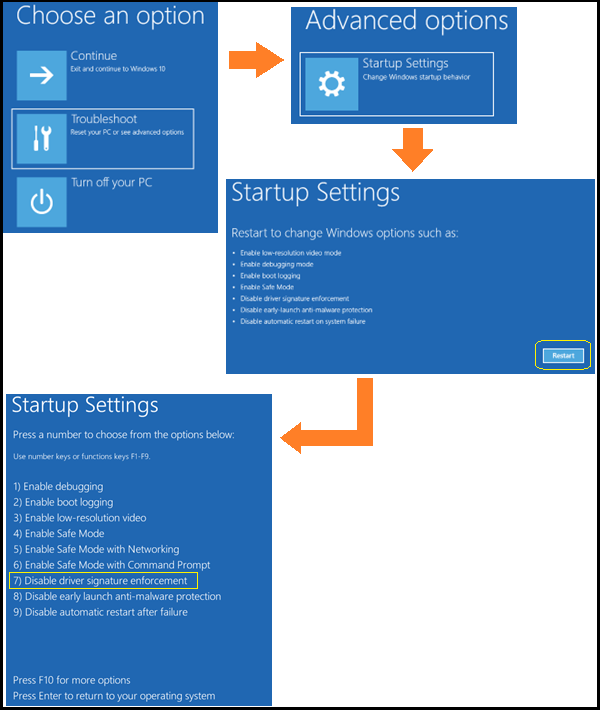
If you get the following error, restart Windows with signed driver checking disabled (hold down the Shift key while restarting).

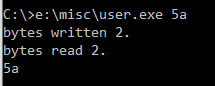
If all goes well you should be able to store a byte in the POST port and read it back out.
To remove the driver run the following commands.
sc stop "testdrv"
sc delete "testdrv"