






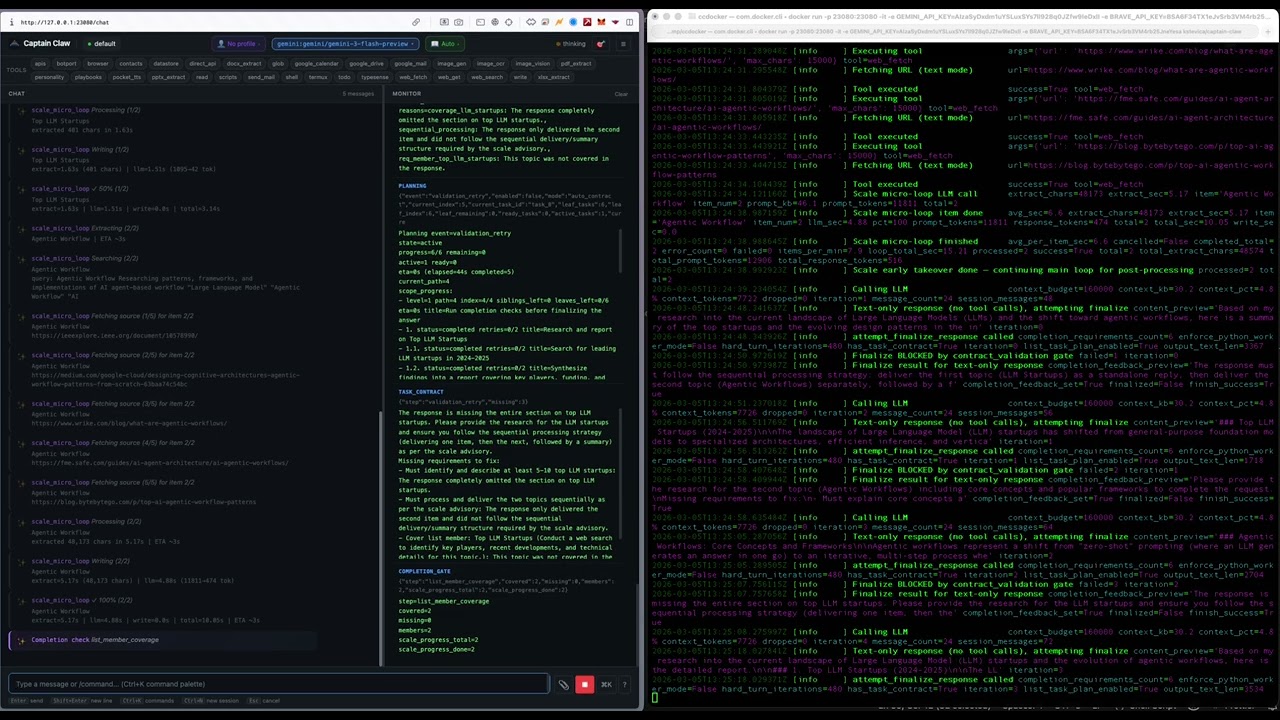
An open-source AI agent that runs locally, supports multiple LLM providers, and gets work done — coding, research, automation, document processing, orchestration — through persistent sessions with built-in safety guards.
| Capability | What it does |
|---|---|
| Multi-model routing | Mix GPT, Claude, Gemini, and Ollama in one CLI |
| Per-session model selection | Keep one session on Claude, another on GPT, another on Ollama |
| Persistent multi-session workflows | Resume any session exactly where you left off |
| Built-in safety guards | Input, output, and script/tool checks before anything runs |
| 27 built-in tools | Shell, files, web fetch/get/search, docs, email, TTS, image gen/OCR/vision, Google Workspace CLI (gws — Drive, Docs, Calendar, Gmail), todo, contacts, scripts, APIs, datastore, deep memory, playbooks, personality, BotPort, Termux (Android) |
| Personality system | Dual-profile system — global agent identity plus per-user profiles for tailored responses |
| Skills system | OpenClaw-compatible skills with auto-discovery and GitHub install |
| Orchestrator / DAG mode | Decompose complex tasks into parallel multi-session execution |
| Memory / RAG | Hybrid vector + text retrieval across workspace and sessions |
| Web UI | Chat, monitor pane, instruction editor, command palette, persona selector, datastore browser, deep memory dashboard |
| BotPort (agent-to-agent) | Route tasks to specialist agents across a network of Captain Claw instances |
| Remote integrations | Telegram (per-user sessions), Slack, Discord with secure pairing |
| Cross-session to-do memory | Persistent task list shared across sessions with auto-capture |
| Cross-session script memory | Persistent script/file tracking with auto-capture from write tool |
| Cross-session API memory | Persistent API endpoint tracking with auto-capture from web_fetch |
| Cross-session playbook memory | Rate sessions to auto-distill reusable orchestration patterns (do/don't pseudo-code) with auto-injection |
| Datastore | SQLite-backed relational tables managed by the agent, with protection rules, import/export, web dashboard, and table export via UI |
| Chunked processing pipeline | Run small-context models (20k–32k tokens) on large content via automatic content chunking |
| Cron scheduling | Interval, daily, and weekly tasks inside the runtime |
| OpenAI-compatible API | POST /v1/chat/completions proxy with agent pool |
Requires Python 3.11 or higher.
python -m venv venv
source venv/bin/activate
pip install captain-claw
Optional extras:
pip install captain-claw[tts]      # Local text-to-speech (pocket-tts, requires PyTorch)
pip install captain-claw[vector]   # Vector memory / RAG (numpy, scikit-learn)
pip install captain-claw[vision] # Image resize before LLM calls (Pillow; or use ImageMagick)export OPENAI_API_KEY="your-openai-key"
export ANTHROPIC_API_KEY="your-anthropic-key"
export GOOGLE_API_KEY="your-google-key"
export GEMINI_API_KEY="your-gemini-key"Use only the keys you need. For Ollama, no key is required — just set provider: ollama in config.yaml.
captain-claw-web          # Web UI (default: http://127.0.0.1:23080)
captain-claw              # Interactive terminal
captain-claw --tui        # Terminal UI
captain-claw --port 8080  # Override web server port
botport                   # BotPort agent-to-agent routing hub
First run starts interactive onboarding automatically — it pre-configures 12 models across OpenAI, Anthropic, and Gemini (including image generation, OCR, and vision). The web UI redirects to /onboarding on first launch too. To re-run it later: captain-claw --onboarding.
If the configured port is busy, Captain Claw automatically tries the next available port (up to 10 attempts).
> Investigate failing integration tests and propose a fix.

/models                          # see available models
/session model claude-sonnet     # switch this session to Claude

/new release-notes               # create a second session
/session model chatgpt-fast      # use GPT for this one

> Draft release notes from the previous session updates.

/session run #1 summarize current blockers   # run a prompt in session #1
Each session keeps its own model, context, and history.
Run captain-claw-web to start the web UI at http://127.0.0.1:23080. Use Ctrl+K for the command palette, Ctrl+B for the sidebar, and edit instruction files live in the Instructions tab.
For the terminal, use captain-claw (interactive) or captain-claw --tui (TUI mode).
docker pull kstevica/captain-claw:latest
docker pull kstevica/captain-claw-botport:latest
You need a config.yaml and .env in the current directory. Both files must exist before running — if they don't, Docker creates empty directories instead and the container fails to start.
Minimal .env — add only the keys you need:
# At least one model API key is required
OPENAI_API_KEY="sk-..."
ANTHROPIC_API_KEY="sk-ant-..."
GOOGLE_API_KEY="AI..."
GEMINI_API_KEY="AI..."

# Ollama (if using local models from within Docker)
OLLAMA_BASE_URL="http://host.docker.internal:11434"
Minimal config.yaml — a working starting point:
model:
  provider: gemini              # openai, anthropic, gemini, ollama
  model: gemini-2.5-flash       # model name for the chosen provider
  temperature: 0.7
  allowed:
    - id: claude-sonnet
      provider: anthropic
      model: claude-sonnet-4-20250514
    - id: gpt-4o
      provider: openai
      model: gpt-4o

web:
  enabled: true
  port: 23080
The first launch starts onboarding automatically and pre-configures models. For the full configuration reference, see USAGE.md.
# Captain Claw web UI
docker run -d -p 23080:23080 \
  -v $(pwd)/config.yaml:/app/config.yaml:ro \
  -v $(pwd)/.env:/app/.env:ro \
  -v $(pwd)/docker-data/home-config:/root/.captain-claw \
  -v $(pwd)/docker-data/workspace:/data/workspace \
  -v $(pwd)/docker-data/sessions:/data/sessions \
  -v $(pwd)/docker-data/skills:/data/skills \
  kstevica/captain-claw:latest

# BotPort (optional, for multi-agent routing)
docker run -d -p 33080:33080 \
  -v $(pwd)/botport/config.yaml:/app/config.yaml:ro \
  -v $(pwd)/.env:/app/.env:ro \
kstevica/captain-claw-botport:latest- Web UI: http://localhost:23080
- BotPort dashboard: http://localhost:33080
If you cloned the repo, use the included docker-compose.yml:
docker compose up -d                # both services
docker compose up -d captain-claw   # web UI only
docker compose up -d botport # BotPort onlyAll persistent data is stored under ./docker-data/ on the host:
| Host path | Container path | Contents |
|---|---|---|
./docker-data/home-config/ |
/root/.captain-claw/ |
Settings saved from the web UI |
./docker-data/workspace/ |
/data/workspace/ |
Workspace files |
./docker-data/sessions/ |
/data/sessions/ |
Session database |
./docker-data/skills/ |
/data/skills/ |
Installed skills |
Configuration (config.yaml) and secrets (.env) are mounted read-only from the current directory.
docker compose up -d --build    # rebuild after code changes
docker compose logs -f          # follow logs
docker compose down             # stop all services
See USAGE.md for the full Docker reference.
Sessions are first-class. Create named sessions for separate projects, switch instantly, and persist everything.
/new incident-hotfix
/session model claude-sonnet
/session protect on                            # prevent accidental /clear
/session procreate #1 #2 "merged context"      # merge two sessions
/session run #2 summarize current blockers     # run prompt in another session
/session export all                            # export chat + monitor history
Captain Claw ships with 27 built-in tools. The agent picks the right tool for each task automatically.
| Tool | What it does |
|---|---|
shell |
Execute terminal commands |
read / write / glob |
File operations and pattern matching |
web_fetch |
Fetch and extract readable text from web pages (always text mode) |
web_get |
Fetch raw HTML source for scraping and DOM inspection |
web_search |
Search the web via Brave Search API |
pdf_extract |
Extract PDF content to markdown |
docx_extract |
Extract Word documents to markdown |
xlsx_extract |
Extract Excel sheets to markdown tables |
pptx_extract |
Extract PowerPoint slides to markdown |
image_gen |
Generate images from text prompts (DALL-E 3, gpt-image-1) |
image_ocr |
Extract text from images via vision-capable LLMs |
image_vision |
Analyze and describe images via vision-capable LLMs |
pocket_tts |
Generate speech audio (MP3) locally |
send_mail |
Send email via SMTP, Mailgun, or SendGrid |
gws |
Google Workspace CLI — Drive, Docs, Sheets, Slides, Gmail (read), and Calendar via the gws binary |
todo |
Persistent cross-session to-do list with auto-capture |
contacts |
Persistent cross-session address book with auto-capture |
scripts |
Persistent cross-session script/file memory with auto-capture |
apis |
Persistent cross-session API memory with auto-capture |
datastore |
Manage relational data tables with CRUD, import/export, raw SQL, and protection rules |
personality |
Read or update the agent personality and per-user profiles |
typesense |
Index, search, and manage documents in deep memory (Typesense) |
playbooks |
Persistent cross-session orchestration pattern memory with auto-distillation |
botport |
Consult specialist agents through the BotPort agent-to-agent network |
termux |
Interact with Android device via Termux API (camera, battery, GPS, torch) |
See USAGE.md for full parameters and configuration.
Three built-in guard types protect against risky operations:
guards:
  input:
    enabled: true
    level: "ask_for_approval"     # or "stop_suspicious"
  output:
    enabled: true
    level: "stop_suspicious"
  script_tool:
    enabled: true
    level: "ask_for_approval"
Guards run before LLM requests (input), after model responses (output), and before any command or tool execution (script_tool). See USAGE.md for details.
Captain Claw is YAML-driven with environment variable overrides.
model:
  provider: "openai"
  model: "gpt-4o-mini"
  allowed:
    - id: "claude-sonnet"
      provider: "anthropic"
      model: "claude-sonnet-4-20250514"

tools:
  enabled: ["shell", "read", "write", "glob", "web_fetch", "web_search",
            "pdf_extract", "docx_extract", "xlsx_extract", "pptx_extract",
            "image_gen", "image_ocr", "image_vision",
            "pocket_tts", "send_mail", "gws", "todo", "contacts", "scripts",
            "apis", "datastore", "playbooks", "personality", "botport", "termux"]

web:
  enabled: true
  port: 23080
Load precedence: ./config.yaml > ~/.captain-claw/config.yaml > environment variables > .env file > defaults.
For the full configuration reference (23 sections, every field), see USAGE.md.
Each of these is documented in detail in USAGE.md.
-
Orchestrator / DAG mode —
/orchestratedecomposes a complex request into a task DAG and runs tasks in parallel across separate sessions with real-time progress monitoring. Also available headless viacaptain-claw-orchestrate. -
Skills system — OpenClaw-compatible
SKILL.mdfiles. Auto-discovered from workspace, managed, and plugin directories. Install from GitHub with/skill install <url>. -
Memory / RAG — Hybrid vector + text retrieval. Indexes workspace files and session messages. Configurable embedding providers (OpenAI, Ollama, local hash fallback).
-
Cross-session to-do memory — Persistent task list shared across sessions. Auto-capture from natural language, context injection to nudge the agent, and full
/todocommand support across CLI, Web UI, Telegram, Slack, and Discord. -
Cross-session address book — Persistent contact memory that tracks people across sessions. Auto-captures from conversation and email, auto-computes importance from mention frequency, and injects relevant contact context on demand.
-
Cross-session script memory — Persistent tracking of scripts and files the agent creates. Auto-captures from the
writetool when executable extensions are detected. Stores path + metadata (no file content in DB). On-demand context injection when script names appear in conversation. -
Cross-session API memory — Persistent tracking of external APIs the agent interacts with. Auto-captures from
web_fetchandweb_getwhen API-like URLs are detected. Stores credentials, endpoints, and accumulated context. On-demand context injection when API names or URLs appear in conversation. -
Cron scheduling — Pseudo-cron within the runtime. Schedule prompts, scripts, or tools at intervals, daily, or weekly. Guards remain active for every cron execution.
-
Execution queue — Five queue modes (steer, followup, collect, interrupt, queue) control how follow-up messages are handled during agent execution.
-
BotPort (agent-to-agent) — Connect multiple Captain Claw instances through the BotPort routing hub. Agents can delegate tasks to specialist instances based on expertise tags, persona matching, or LLM-powered routing. Supports bidirectional follow-ups, context negotiation, and concern lifecycle management. Included with
pip install captain-claw— runbotportto start a hub, then connect instances via WebSocket (e.g.wss://botport.kstevica.com/ws). -
Remote integrations — Connect Telegram, Slack, or Discord bots. Telegram users get isolated per-user sessions with concurrent agent execution. Unknown users get a pairing token; the operator approves locally with
/approve user. -
OpenAI-compatible API —
POST /v1/chat/completionsendpoint proxied through the Captain Claw agent pool. Streaming supported. -
Google Workspace CLI (gws) — Access Google Drive, Docs, Sheets, Slides, Gmail (read), and Calendar through the
gwsCLI binary. Search and download Drive files, read Google Docs/Sheets/Slides inline (Sheets exported as XLSX with all sheets, Presentations as PPTX with all slides), create Google Docs, list and search emails, view calendar agenda and create events. The scale loop automatically processes Google Drive file lists without manual file-ID handling. Supports arawpassthrough mode for anygwscommand. Requires separategwsCLI installation and authentication. -
Datastore — SQLite-backed relational data tables managed entirely by the agent. 19 tool actions cover schema management, CRUD operations, raw SELECT queries, CSV/XLSX import and export, and a four-level protection system (table, column, row, cell). Includes a web dashboard for browsing tables, editing rows, running SQL, uploading files, and exporting tables as CSV/XLSX/JSON.
-
Deep Memory (Typesense) — Long-term searchable archive backed by Typesense. Indexes processed items from the scale loop, web fetches, and manual input. Hybrid keyword + vector search. Separate from the SQLite-backed semantic memory. Includes a web dashboard for browsing, searching, and managing indexed documents.
-
Playbooks — Persistent cross-session orchestration pattern memory. Rate sessions as good/bad to auto-distill reusable do/don't pseudo-code patterns. Playbooks are auto-injected into planning context when similar tasks are detected, improving decision quality over time. Includes a web editor and REST API.
-
Send mail — SMTP, Mailgun, or SendGrid. Supports attachments up to 25 MB.
-
Termux (Android) — Run Captain Claw on Android via Termux. Take photos with front/back camera (auto-sent to Telegram), get GPS location, check battery status, and toggle the flashlight — all through the Termux API.
-
Document extraction — PDF, DOCX, XLSX, PPTX converted to markdown for agent consumption.
-
Chunked processing pipeline — Enables small-context models (20k–32k tokens) to process large content. A context budget guard detects when content exceeds the available window, splits it into sequential chunks, processes each with full instructions, and combines partial results via LLM synthesis or concatenation. Integrates transparently with the scale loop micro-loop.
-
Context compaction — Auto-compacts long sessions at configurable thresholds. Manual compaction with
/compact. -
Personality system — Dual-profile system with a global agent identity (name, background, expertise) and per-user profiles that tailor responses to each user's perspective. Editable via the
personalitytool, REST API, or the Settings page. Telegram users get automatic per-user profiles. -
Session export — Export chat, monitor, pipeline trace, or pipeline summary to files.
pip install -e ".[dev]"
pytest
ruff check captain_claw/| Path | Role |
|---|---|
captain_claw/agent.py |
Main orchestration logic |
captain_claw/llm/ |
Provider abstraction (OpenAI, Anthropic, Gemini, Ollama) |
captain_claw/tools/ |
Tool registry and 26 tool implementations |
captain_claw/personality.py |
Agent and per-user personality profiles |
captain_claw/session/ |
SQLite-backed session persistence |
captain_claw/skills.py |
Skill discovery, loading, and invocation |
captain_claw/session_orchestrator.py |
Parallel multi-session DAG orchestrator |
captain_claw/semantic_memory.py |
Hybrid vector + text retrieval (RAG) |
captain_claw/datastore.py |
SQLite-backed relational datastore |
captain_claw/deep_memory.py |
Typesense-backed long-term archive |
captain_claw/botport_client.py |
BotPort WebSocket client |
captain_claw/google_oauth_manager.py |
Google OAuth token management |
captain_claw/cli.py |
Terminal UI |
captain_claw/web/ |
Web server (WebSocket + REST + static) |
captain_claw/orchestrator_cli.py |
Headless orchestrator CLI |
captain_claw/agent_chunked_processing_mixin.py |
Chunked processing pipeline for small-context models |
captain_claw/config.py |
Configuration and env overrides |
captain_claw/instructions/ |
Externalized prompt and instruction templates |
Is Captain Claw only for coding? No. It handles coding, ops automation, web research, document processing, email, and multi-session orchestration.
Can I use local models only?
Yes. Set provider to ollama and run fully local.
Can I run different models at the same time? Yes. Model selection is per session. Different sessions can use different providers and models simultaneously.
Do I need guards enabled? No. Guards are off by default. Enable them when you want stricter safety behavior.
Is there a web interface?
Yes — it's the default. Run captain-claw and open http://127.0.0.1:23080. Same agent, sessions, tools, and guardrails as the terminal. Use --tui for the terminal UI.
Where is the full reference? See USAGE.md for comprehensive documentation of every command, tool, config option, and feature.
python -m venv venv && source venv/bin/activate
pip install captain-claw
captain-claw-web
If Captain Claw is useful to you, give the repo a star to help others find it.
Found a bug or have a feature idea? Open an issue. Contributions welcome.

