Code repository for https://www.nature.com/articles/s41598-021-89015-8

NOTE: The file "M_ALL_006.hdf5" is the trained TensorFlow model.
A typical machine learning workflow involves creating a small inventory manually to train a supervised model, which is further used to map landslides in the surrounding areas of interest. This saves a lot of time and effort, however, it is still not suitable for a fully automated rapid mapping scenario as human intervention is required for creating the initial training inventory.
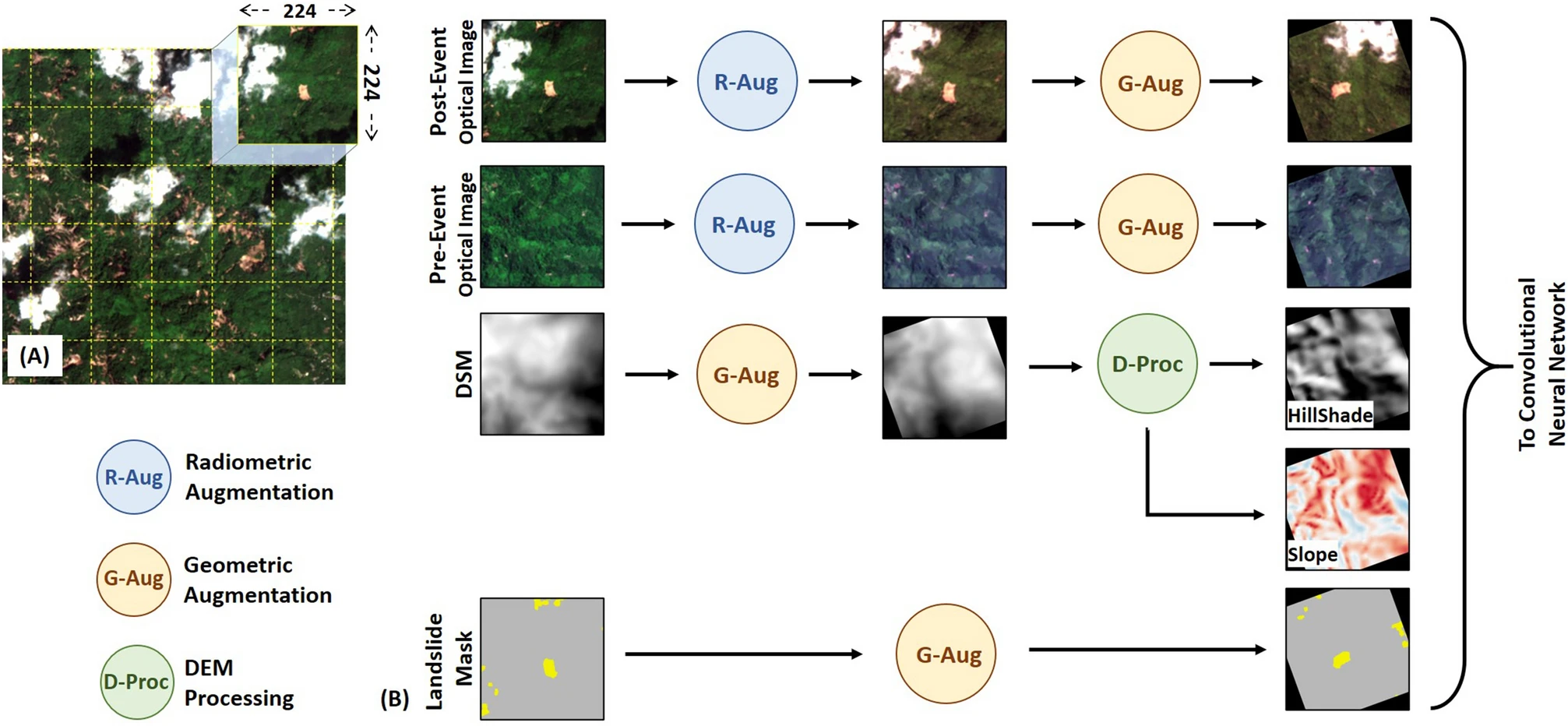
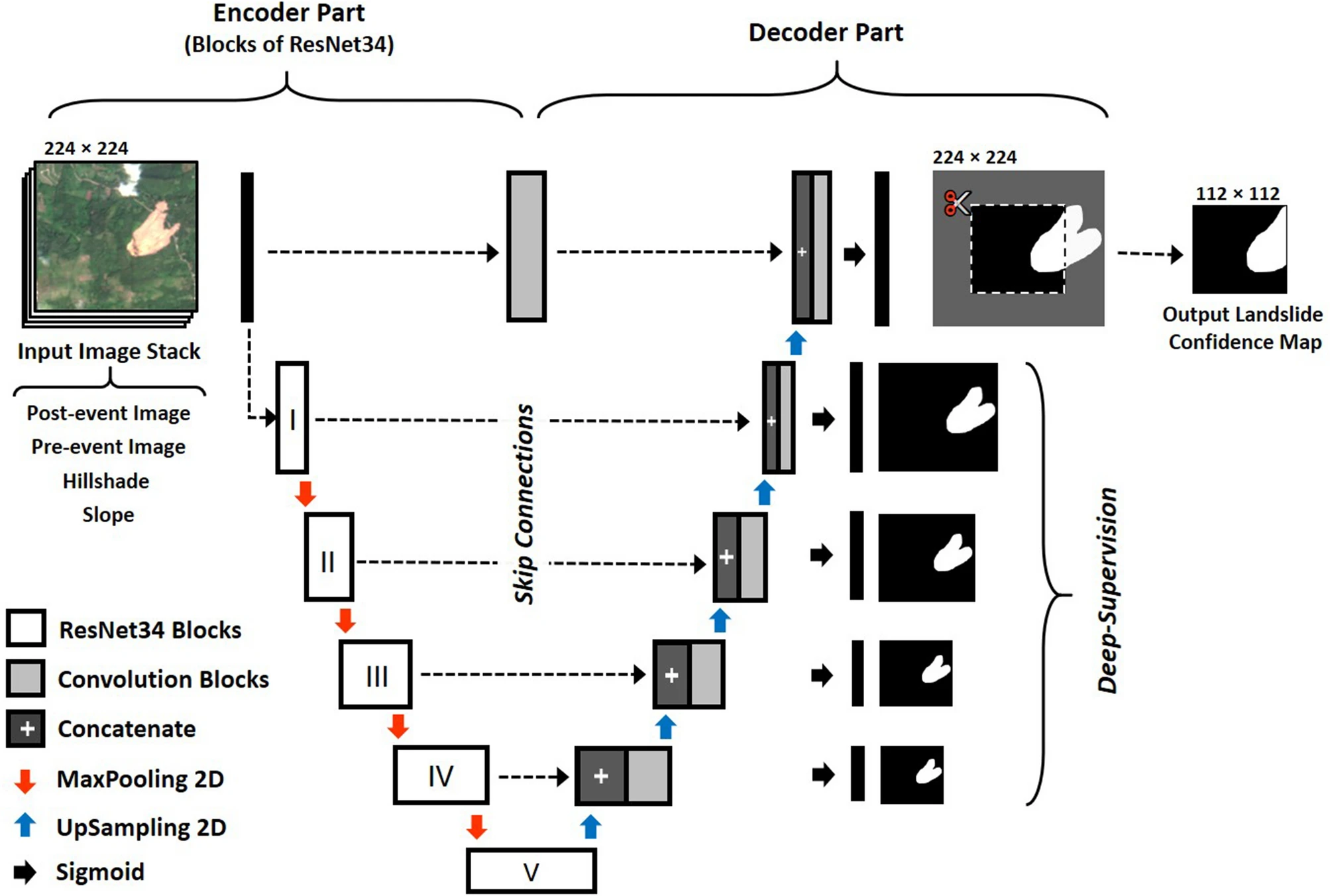
This repository shares a generalized deep-learning model which can be used to map landslides triggred by large earthquakes or extreme rainfall events. It can be used on medium resolution EO data (resolution: 5 - 10 meters, like Sentinel-2, Rapid-Eye, etc). It can be used directly without training for a specific event / georgaphic location.

Result of landslide mapping. (A) The density map showing the distribution of induced landslides identified by the generalized CNN. (B) - (E) Multiple views from the study area showing changes observed in Sentinel-2 images from before and after the triggering event. The landslides identified by the CNN has been marked as red polygons in the post-event images. Figure (E) is an example of false-positive detection due to cloud shadow, which was not identified by the Fmask algorithm.