Focus point distance filter - #1323
Conversation


9a85b0c to
65b7b4c
Compare

|
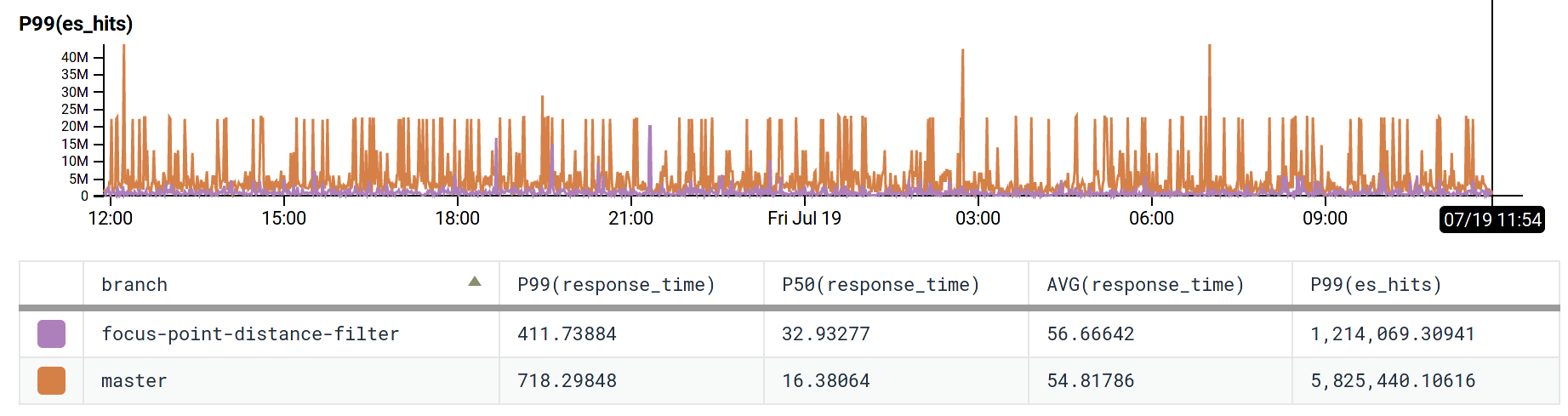
We have been running this on some of our geocode.earth traffic for the last 24 hours. The results are in and they are...interesting: First, there is a nice decrease in both p99 latency and the number of Elasticsearch hits (as expected), but there is also a notable increase in the p50 latency. I wonder if the addition of the |

65b7b4c to
4a21f92
Compare
6e69922 to
4b193d2
Compare
|
Hello again! Filtering out all autocomplete queries without a focus point, and for text lengths 9 or greater, a very different picture emerges: So it looks like this change does do a great job of cutting off the long tail of slow autocomplete queries, without increasing the total workload on Elasticsearch, and without unduly slowing down already fast autocomplete queries. With that, I think it's good to go, although I'm sure we will tweak it later. |

This change uses an extra filter clause that takes into account a focus
point (if used) and the input text length to filter out very far away
street and adress records, improving performance.

Replaces #1215
4b193d2 to
17e2275
Compare

1 participant

This PR builds on the work in #1215 to improve the performance of autocomplete queries with the
focus.pointparameter, while ensuring the results are as similar as possible.It works by adding an Elasticsearch filter to autocomplete queries. Results must now pass one of the following tests to be scored and shown:
The allowed distance grows with the text length, and after some experimentation I settled on a hand tuned table of distances. As it stands the filter is active up to text lengths of 8, although the distance limit is a generous 2000km by then.
Currently, addresses and streets represent 565 million of the 605 million records in a full planet index, or about 93%. So in some cases this can filter out lots of results.
There are zero changes at all to either the acceptance tests or autocomplete acceptance tests, which hopefully confirms this change is pretty conservative. I feel like that's a great way for it to start out, and then we can tweak it more over time.
Potential future work
There are several things this PR doesn't try to tackle at all but that we should do in the future, using the groundwork laid here.
I actually really like the filter pattern used, with several clauses in the
shouldblock andminimum_should_matchset to one. This basically means we could easily add more conditions and as long as any one of them is true, the record will not be filtered outPopularity
Once we have more popularity values from work like pelias/openstreetmap#493 we could experiment with filtering out far away results below a popularity threshold. This would allow us to filter out some of the ~30 million venues, and possibly some of the 6.5M localities, currently in the index, providing another nice boost to performance.
Zoom
The example of searching for addresses in Australian coastal cities with a viewport centered on the middle of Australia was raised in pelias/pelias#658. This PR doesn't make that case worse, but it doesn't help either.
However, if we did introduce a zoom parameter, we could consider having it modify the distance limits so that the entire viewport was likely to be within that limit.