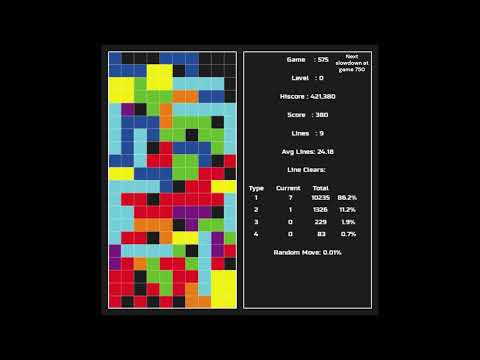


This project is an AI-driven Tetris player built using Python and Pygame. It leverages Deep Q-Networks (DQN), Double DQN, Prioritized Experience Replay, and Genetic Algorithms to train an agent that can efficiently play Tetris. The project underwent significant optimizations from Version 1 to Version 2 to enhance training speed and efficiency.
The game environment follows NES Tetris rules, implementing:
- Scoring system similar to NES Tetris.
- Gravity mechanics for line clears.
The AI interacts with the game through state-based decisions, selecting moves from all possible placements and rotations.
The initial AI agent was based on Deep Q-Learning (DQN), which uses a single neural network to estimate both current and target Q-values. However, this approach had issues with Q-value overestimation and early convergence, leading me to explore improvements.
- Tetris has a well-defined state space: represent the board state using 6 features (
total_height, bumpiness, holes, line_cleared, y_pos, pillar). - The agent selects only one action per move, making Q-learning a good fit for evaluating discrete actions efficiently.
- Experience Replay helped stabilize learning by allowing the agent to learn from past moves, improving long-term decision-making.
- With this setup, some agents achieved 500+ lines by game 10,000, demonstrating strong learning potential.
- Initially, I implemented Double Q-Learning, which separates action selection from Q-value estimation to reduce overestimation bias.
- This led to more accurate value estimations, improving learning stability.
I later adopted Double DQN (DDQN), which expands on Double Q-Learning by using two separate neural networks:
- Primary Network: Predicts actions and updates every 200 pieces placed.
- Target Network: Computes target Q-values and updates every 1000 pieces to provide more stable training.
This approach reduces instability in training, prevents premature convergence, and allows the agent to generalize better across different board states.
Initially, my agent used Experience Replay, where past experiences were randomly sampled for training. This method helped the agent make long-term decisions by allowing it to learn from past moves, rather than relying solely on recent experiences.
However, random sampling treats all experiences equally, even though some experiences provide more learning value than others. To improve this, I implemented Prioritized Experience Replay (PER).
- Instead of selecting experiences at random, PER selects experiences based on their TD error (Temporal Difference Error).
- TD Error = Difference between predicted and actual Q-values.
- High TD Error → The agent’s prediction was far off, meaning there’s more to learn from this experience.
- Low TD Error → The agent already understands this experience well, meaning less learning value.
By prioritizing high TD error experiences, the agent learns from its biggest mistakes first, leading to faster and more efficient training—especially in early stages.
- I replaced the traditional deque-based replay buffer with a heap-based structure, allowing efficient retrieval of high-priority experiences.
- The heap keeps track of the maximum TD error, ensuring that the most informative experiences are sampled more frequently.
This approach significantly improved early training efficiency, allowing the agent to focus on valuable experiences rather than wasting computation on redundant ones.
A well-balanced reward function was necessary to help the agent learn long-term strategies. Simply rewarding line clears resulted in poor planning, so I introduced sparse rewards to encourage better board management.
- Minimal bumpiness → Smoother surfaces for easier line clears.
- Minimal holes → Avoiding trapped empty spaces.
- Small pillars → Preventing difficult-to-clear structures.
- Penalties for increasing bumpiness, holes, or large pillars.
- Punishment for stacking too high to prevent early game over.
- Encouragement for moves that improve board stability.
A good move in Tetris does not always have an immediate impact. The agent may place a piece that sets up a Tetris many moves later.
- Short-term rewards (clearing a single line) might seem optimal, but setting up for a Tetris (4-line clear) is more valuable.
- Experience Replay helps the agent revisit earlier moves that contributed to major rewards later, reinforcing good strategies.
- Discount Factor (Gamma = 0.999) ensures that the agent values long-term rewards, preventing greed for short-term gains.
By considering the delayed impact of moves, the agent learns how to set up better board states, instead of focusing only on immediate rewards.
Instead of relying solely on a typical decay schedule, I combined it with an alternating strategy between high exploration and high exploitation in 500-game cycles. This method sped up learning while maintaining stability.
- Epsilon:
0.3 → 0.0001 - Learning Rate (LR):
0.01 → 0.001 - Since the agent has 10-40 move choices per state, high exploration encourages broader strategy discovery.
- A higher learning rate (LR) allows more aggressive updates, helping the agent learn board setup strategies faster.
- Epsilon:
0.0001 - Learning Rate (LR):
0.001 - The agent tests its learned strategies from the exploration phase.
- Lower LR prevents drastic updates, refining the strategy without overfitting.
- This phase stabilizes the agent's learning, similar to how stocks correct after a surge.
- First cycle: The agent explored without prior knowledge.
- Second cycle: The agent explored with refined strategies, leading to more targeted discoveries.
- Another 500-game exploration phase allowed for additional improvements.
- Final exploitation phase fine-tuned an even better strategy.
This alternating method allowed the agent to learn, refine, explore deeper, and perfect its strategy.
Balancing the reward function for Tetris AI proved to be extremely difficult:
- Punishing holes too much led to agents building tall pillars.
- Punishing pillars too much made agents cover them too early, avoiding Tetris clears.
- Over-rewarding Tetris clears made agents stack high and wait for an I-piece, often leading to failure.
- Under-rewarding Tetris clears led to single and double line clears, missing higher scores.
Initially, tuning these rewards required manually adjusting values and running 500+ games per test—an impractical and slow process. Genetic Algorithms (GA) provided a brute-force approach to optimizing these parameters efficiently.
Taking inspiration from natural selection (survival of the fittest), I designed the GA to evolve the best reward function by:
- High exploration early on, allowing diverse strategies to develop.
- Gradual transition to exploitation, refining the best strategies over generations.
Each agent’s performance was measured by its average number of lines cleared over 500 games.
We used a hybrid of elite selection and tournament selection:
- Elite Selection (50%): The top 50% of agents were directly passed to the next generation to preserve high-performing strategies.
- Tournament Selection (50%): The remaining 50% were selected randomly from the top-performing agents, maintaining diversity.
- Offspring inherited reward function parameters from parents.
- Used a mix of Uniform and Alpha crossover:
- 100% uniform crossover in early generations (high randomness).
- Gradually transitioned to 100% alpha crossover by generation 100 (favoring one parent’s values).
- This ensured high exploration early on and stable exploitation later.
- 50% mutation rate early on, ensuring diverse strategies.
- Gradually decayed to 5% by generation 100, stabilizing learned behaviors.
- Mutations introduced small adjustments to reward parameters, preventing premature convergence.
This exploration-to-exploitation strategy allowed me to discover an optimal balance of rewards, creating a highly competitive AI.
-
Version 1: The project was not originally designed to handle multiple game boards in one window. As a workaround, I used multiprocessing, giving each agent its own CPU core. However, this approach limited me to 10 agents, constrained by available CPU processors.
-
Version 2: Knowing I wanted many agents running at once, I redesigned the project to support multiple boards within a single process. This eliminated the need for multiprocessing, allowing the computer to efficiently manage tasks internally. Thanks to optimizations, I increased the number of agents from 10 to 250.
- Rendering inefficiencies – Redrawing static elements every frame.
- State calculation overhead – Dropping pieces in all possible positions consumed excessive time.
- Old Approach: Redrew every block in every frame.
- New Approach: Used dirty rects (only updating changed areas).
- Result: Rendering time reduced from 90s → 5s.
- Old Approach: Used Python loops, making
calc_all_states()slow (~180s). - New Approach: Rewrote with Numba’s njit for machine code execution.
- Result: Execution time reduced from 180s → 15s.
- Blitting Optimization: Rendered directly to the main screen instead of intermediate surfaces.
- Batch Processing: Consolidated multiple small calculations into fewer large ones.
- Reduced Redundant Board Operations: Minimized unnecessary board evaluations.
These optimizations allowed seamless Genetic Algorithm training, unlocking massive scalability improvements.
223807016 function calls (210035110 primitive calls) in 483.520 seconds

Ordered by: cumulative time

ncalls tottime percall cumtime percall filename:lineno(function)

1        2.155    2.155  481.741  481.741 train.py:85(run_simulation)
42254    0.305    0.000  206.318    0.005 tetris.py:87(play_full)
82161    0.575    0.000  205.107    0.002 tetris.py:139(play_step)
42383   12.129    0.000  180.555    0.004 game.py:203(calc_all_states)
82160    0.253    0.000  114.913    0.001 game.py:250(run)
1005317  4.698    0.000  96.764     0.000 game.py:311(hard_drop)
10562398 16.251   0.000  92.066     0.000 game.py:316(move_down)
22190082 function calls (20214157 primitive calls) in 52.530 seconds

Ordered by: cumulative time

ncalls tottime percall cumtime percall filename:lineno(function)

1        0.423    0.423   50.491   50.491 main_screen.py:155(run2)
46619    3.519    0.000   20.576    0.000 main_screen.py:113(play_action)
31/21    0.000    0.000   17.968    0.856 _ops.py:291(fallthrough)
698733/140673  0.902    0.000   17.785    0.000 module.py:1735(_wrapped_call_impl)
698733/140673  1.156    0.000   17.579    0.000 module.py:1743(_call_impl)
139515   1.450    0.000   17.034    0.000 model.py:12(forward)
- Total runtime reduced from 483.52s → 52.53s (≈89% speedup)
calc_all_states()reduced from 180s → ~15s- Rendering reduced from 90s → ~5s
- Overall, training is significantly faster and more scalable.
To run the AI, navigate to the appropriate version and execute:
pip install -r requirements.txtcd Version1
python -c "import train; train.run_game(True)" # Enable slow drop
python -c "import train; train.run_game(False)" # Disable slow dropcd Version2
python genetic_algo.py